- We make telecom meet the cloud or modern IT
- We specialize in telco grade software and solutions regarding Voice, Video SMS, billing and others
1. About Telcobrigtht SMS Platform
2. How the platform can be used by an Enterprise
Independent SMS software
API Platform
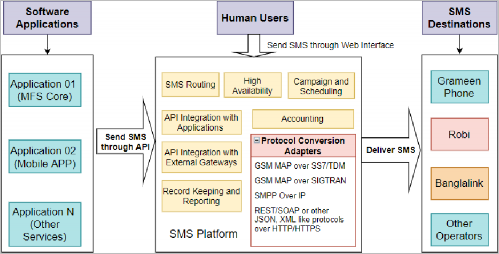
In both modes, the platform interfaces with the clients and the suppliers’ gateway using any protocol, for example, it can receive an SMS over GSM/MAP SMPP protocol and send it out to an egress route over HTTP/REST and vice-verse. The protocol conversion is seamless- users, admins and other processes interact with the system in the same manner. For instance, the same business logic for accounting and routing will be executed regardless of ingress, egress protocol.
3. Our Value Propositions
Swipe sideways to see the whole table →
ITEM | DESCRIPTION | ADDITIONAL REMARK |
MAIN SOFTWARE | A robust and high-performance SMS Routing Platform | Source Code (Optional) |
FUNCTIONS | Can be used as | Installation, Commissioning, Testing, Support (AMC) included. (Training included) |
ARCHITECTURE | Event-driven, Micro services architecture. Fault tolerant. Services are distributed and decoupled. Clear separation of concern by segregating responsibilities among services. | Most of the existing solutions in the market are monolithic applications which are outdated by design. |
CORE MESSAGING ENGINE | Based on the renowned open-source messaging platform “Apache KAFKA”. KAFKA was originally created by LinkedIn for taking care of distributed messaging and stream processing in the cloud. But after being open-sourced, now used by 80% of the fortune 100 companies in the world use this technology for its durability and performance.Apache Kafka Who are | |
API DRIVEN DESIGN | API driven design allows ease of integration with external applications. | |
SUPPORTED PROTOCOLS | Supported protocols: 1. GSM MAP over SIGTRAN 2. SMPP (version 3.4, 3.3, 5.0) 3. REST, Custom HTTP/ HTTPS or JSON/XML based protocols | |
SMSC MODE | Being a multi-protocol SMS Gateway, we can connect an enterprise directly with operators HLR and MSC over SIGTRAN if the connectivity can be arranged. This bypasses a lot of middleware layers in the operator’s network and ensures highest service quality by minimizing latency while delivering SMS to subscribers. Delivery report are also immediately in most cases. | |
CAMPAIGN AND SCHEDULING | Users can upload bulk SMS tasks for thousands of subscribers from excel or csv files. The batch workload is called a campaign which can be run immediately or at a future date with flexible | |
CDR generation and reporting CDR generation for record keeping and reporting. With optional mediation, rating and invoicing with additional feature-rich telco- grade billing system. | ||
SERVICES | Consultation on source-code integration and training included if purchased with source code. | Optional |
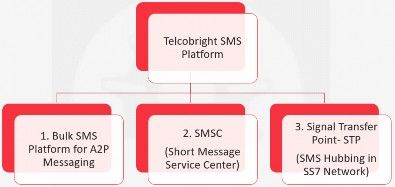
- Bulk/mass SMS campaign manager,
- Application to people (A2P) SMS
- SMS delivery platform for software applications.
- SMSC (P2P) [not considered within current scope]
- SMS Gateway between operators in SS7/SIGTRAN network [not considered within current scope]
4. SMS Platform Features at a Glance
Swipe sideways to see the whole table →
Basic Features | Encoding and Standard features: |
Performance | |
A2P SMS features | Bulk SMS and Mass Campaign High throughput and reliability to support hundreds of thousands of SMS per day. Supports Mass Advanced Campaign Management Smart campaign management features enable advanced scheduling of campaign at any future date with active and exclude hours. Configurable policy-based options for various retry interval and logic or expiring SMS jobs when required. Masking sender numbers is also handled as part of campaign management.
Prefix based routing is implemented through dial plan approach. Admin configures destinations for prefix through the web interface with priority for each gateway. The system executes routing SMS accordingly.
Accounting for clients are handled through individual billing accounts. Client can top up money (credit) in the account. With credit in hand, client can purchase various SMS packages configured by the system admin. With consumption of each SMS, account balance is automatically deducted and the account gets automatically blocked whenever balance is NIL or exceeds a minimum threshold. Flexible Packages Multiple packages of any number of destinations (for example: country, city, mobile or PSTN operator) can be created based on prefix. Clients can purchase own SMS package or bundle and send SMS if there is balance in the package. Postpaid Operation Optionally client can send unlimited number of SMS on post-paid basis. CDR based post-paid billing and invoicing is used in this case for accounting purpose. Telcobright has a very rich CDR based billing system which is high performance and has powerful billing and rating features. Flush SMS Support Supports modern disappearing messages at end users’ handset for smart notifications on handset. (depends on API support of the terminating gateway) |
Web Portal | Web based portal for admin and users. SMS sending and admin related tasks can easily be handled through this. |
- Multilingual: Unicode encoding to support any language including Bangla.
- Length verification and validation to avoid concatenation of SMS for A2P messaging.
- SMS concatenation during terminating of SMS while working in SMSC mode.
- Configurable and any number of Sender ID or masking
- Ease of integration with various applications through API
- Less time to go live
- Low latency, 3-10 milliseconds per SMS, which is real time and carrier grade
- Priority wise SMS Queue. For example, OTP messages may have higher priority and need to be sent immediately before any other pending messages waiting to an outbound gateway.
- High TPS or throughput limited by the capacity of terminating end only. Through the core engine of Apache KAFKA, thousands of Transactions per seconds (TPS) can be supported in a single server. As KAFKA is an infinitely scalable cluster, the system can be extended to support millions of TPS by adding new server to the node. There are many benchmarks on the web, just one is included below. https://www.metarouter.io/blog-posts/how-we-process-one-billion-events-per-day-with-kafka
- User and password administration
- Send single (ad-hoc) or bulk SMS
- Upload excel or csv files for bulk SMS tasks and create campaign
- View campaign progress and status, also perform campaign administration tasks such as resume and suspend operations.
5. Technology and Software Development Stack at a Glance
5.1. Software Development Tools, Methodology, Books and others


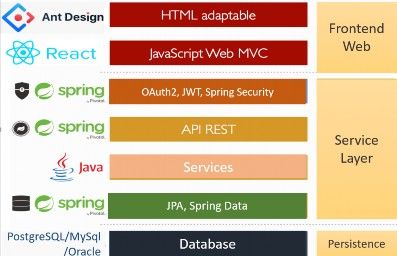
- Single Responsibility Principle
- Open-Close Principle
- Liskov substitution principle
- Dependency Inversion. In addition, DRY (Don’t Repeat Yourself) principles
5.2. DevOPS and Microservices Management Tools
Swipe sideways to see the whole table →
Micro service component | Description | Tools Used |
Inter Service Communication | For different service with send and receive data form each other | Asynchronous, messaging- Kafka Synchronous request/response (Feint client) |
Authentication and Authorization | Provide a common authentication for all services | JWT token, OAuth 2, (Optional) |
Service Discovery | A way for applications and microservices to locate each other on a network | Netflix Eureka |
Service mesh | Microservices orchestration, management and monitoring | Istio |
API gateway and Load Balancer | Connect to services though common gateway for external communication and load balancing | Zuul proxy, Load balancer (Ribbon), Circuit breaker (Hystrix) |
Containerization | Ship code to live server with convenience | Docker |
Log | Lifecycle management for various services logs useful for troubleshooting and monitoring. | ELK stack |
6. Supported Specification and Standards at a Glance

6.1. Short Message Peer-to-Peer (SMPP) Specification
- Protocol: HTTP/HTTPS
- Data Encryption: SSL or VPN
- Transport
- REST over JSON or XML
- SOAP over XML
- Authentication: JSON Web Token (JWT)
SUPPORTED PROTOCOLS:
6.3. HTTP/HTTPS Specifications
- SMPP V3.3
- SMPP V3.4
- SMPP V5.0
Version 1.0
SS7/SIGTRAN Specification
OPEN | |||
3GPP TS 23.040: TECHNICAL REALIZATION OF THE SHORT MESSAGE SERVICE (SMS), BY 3RD | |||
SIGTRAN, |


- https://www.gsma.com/newsroom/wp-content/uploads/2012/12/IR7520.pdf
- https://www.3gpp.org/ftp/Specs/archive/23_series/23.040/
- Stream Control Transmission Protocol (SCTP), RFC 2960, RFC 3873, RFC 4166, RFC 4960.
- Message Transfer Part 3 USER ADAPTATION LAYER (M3UA), RFC 4666.
- Signalling Connection Control Part (SCCP) USER ADAPTATION (SUA), RFC 3868.
- ITU RECOMMENDATION ON TRANSACTION CAPABILITIES ITU Q.771, ITU Q.772, ITU Q.773, ITU Q.774, ITU Q.775
- MOBILE APPLICATION PART BY 3GPP TS 09.02 (MAP V1, MAP V2), 3GPP TS 29.002 (MAP V3)
7. Solution Overview
7.1 Block Diagram
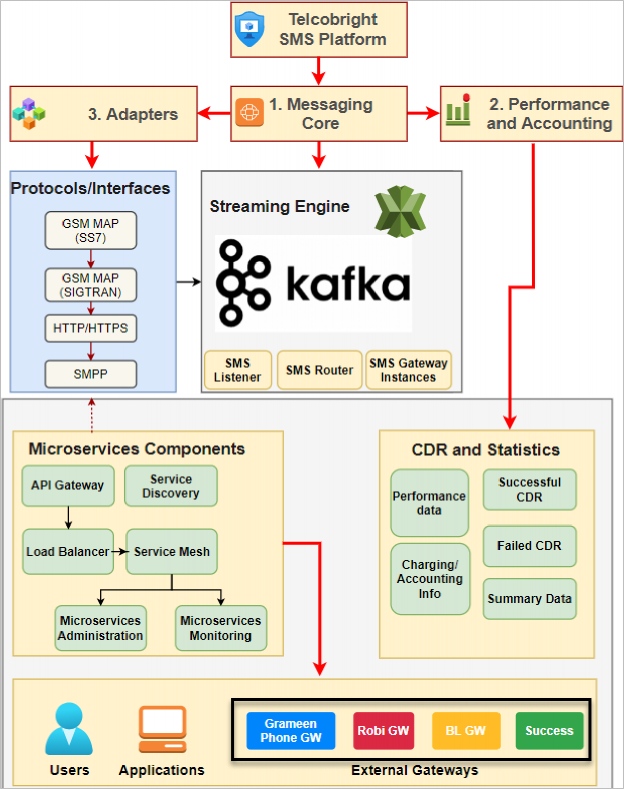
7.2 Architecture and Overview of the SMS Processing Pipeline
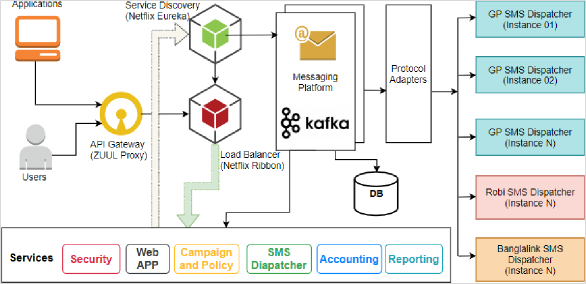
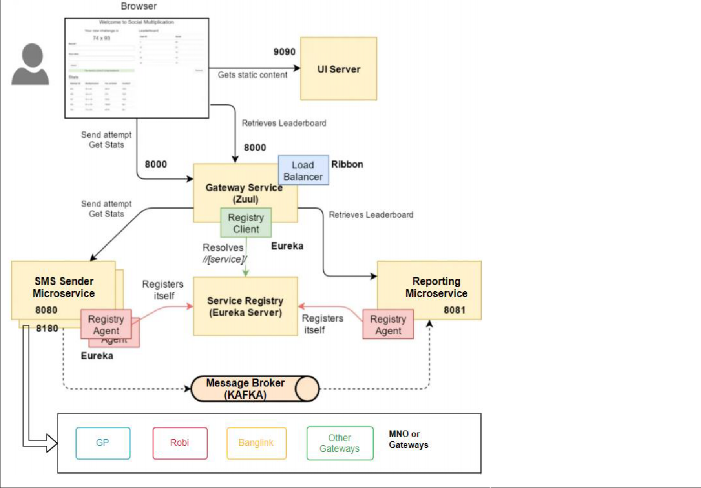
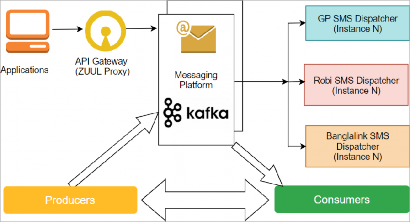
- Business logics are programmed in services, for example SMS sending logics are built in “SMS Sender Microservice”. There are other services like the “Reporting Microservice”. Unlimited number of instances can be deployed for each service to achieve higher throughput or horizontal scalability.
- Services are configured to register themselves to Service Registry Servers through Service Discovery Protocol. We use Netflix Eureka as the service registry server.
- We use “Netflix Zuul” proxy as the API Gateway, which interfaces with the external world and balances all incoming load through a load balancer also from Netflix called “Ribbon”.
- When the API GW receives an SMS request, it dispatches it to the ”SMS Sender” service which sends the SMS out through a Gateway service.
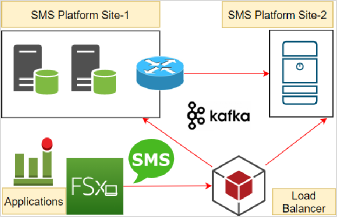
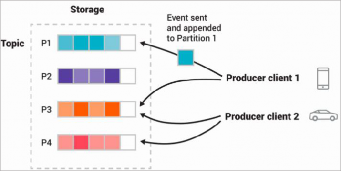
- KAFKA, at the heart of the system, plays important roles to ensure durability in the system, which is explained in the section below.
7.3 How “Apache KAFKA” HELPS US CREATE A POWERFUL SMS PLATFORM
8. Hardware Recommendation
However, the system can run equally well in a fully virtualized environment. In the absence of a dedicated server environment, VM and container allocation is performed through workshops with our clients.
general guideline without specific knowledge of the traffic profile, the following server configurations should be enough to meet the computing and storage requirements for processing 5 Million SMS per day.
Swipe sideways to see the whole table →
Purpose or Service | Resource or Hardware Type | Quantity | Minimum Specifications | Remark |
1. SMS Cluster Node | Server | 3 | Processor type: Intel Xeon Gold No of core: 12 RAM: 32 GB Storage: 100 GB (Raid OS: | SSD storage |
2. Mediation Server | Server | 2 | Processor type: Intel Xeon Gold No of core: 8 RAM: 32 GB Storage: 500 GB (Raid 5 or 6) OS: | CDR based mediation for accounting and performance recording. |
9. Important Modules and Services at a Glance
Swipe sideways to see the whole table →
MODULE | SERVICE | PURPOSE |
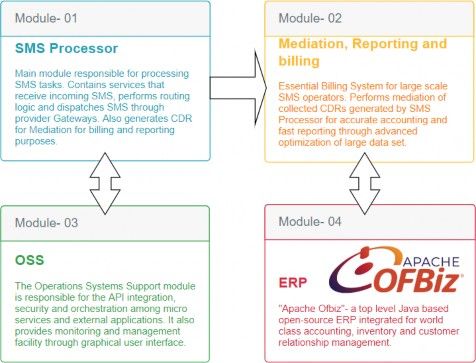
01. SMS PROCESSOR | SMS Listener | Listens for incoming SMS request from applications and the web app. Then performs the routing based on operator’s preference. It distributes the traffic among the available SMS Gateway service instance. |
SMS Gateway | It contains multiple gateway service instances for outgoing carriers, such as: Grameen phone, Robi or other operators. Each gateway service providers may implement different protocols (e.g. SMPP/ HTTP or SIGTRAN). Regardless of the differences in protocols and in connection | |
Short Message Service Center (SMSC) | A cost effective SMSC solutions, being used by PSTN/IP Telephony operators to send SMS to mobile operators. We have both open-source and proprietary solution depending on traffic volume or TPS of the customer. For small to medium customers, we use open-source technology and for operators requiring high TPS, we use Dialogic DSI G5V programmable STP. | |
02. | Mediation, Reporting and Billing | For large |
03. OSS | Microservices Management and Orchestration | Contains the necessary tools used to manage the orchestration and monitoring of the microservices tools. This module enables communications among the services and offers monitoring |
04. ERP (APACHE OFBIZ) | Accounting and CRM | A top-level java based open-source ERP system by Apache foundation. Offers world class accounting, inventory, catalog/warehouse management. We use this module for party management and accounting purpose including accounts receivable, payable, invoices, payments and |
10. Reporting and Analytics
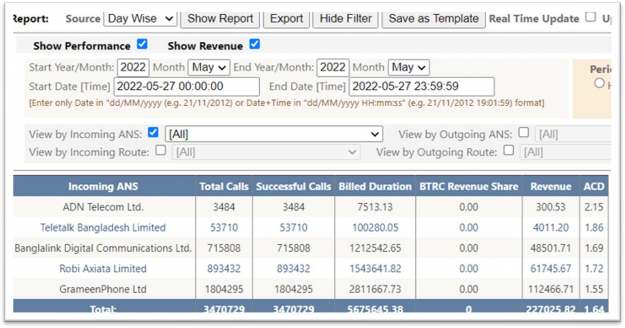
Any to Any Reporting
- Incoming client, user account or an application
- Destinations (e.g. GP/Robi)
- Specific client to specific destination
- Hourly report
- Daily reports
- Failure cause codes and others.
11. Implementation Overview of different Protocols of SMS
11.1 General Process Flow (Protocol Independent)
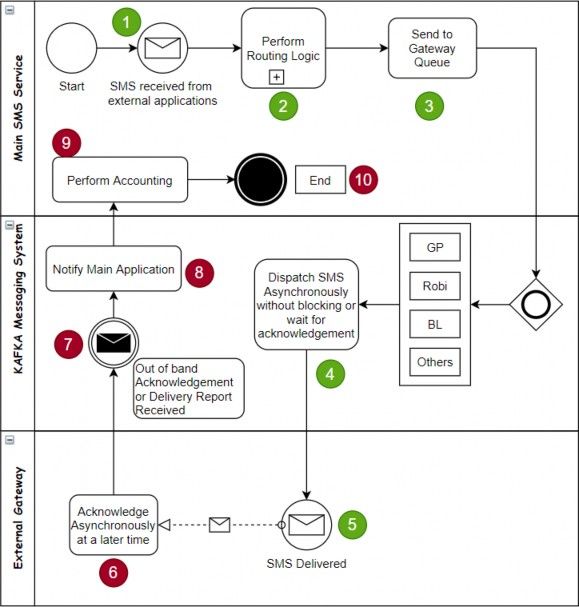
11.2 SMPP Implementation Overview
Supported SMPP Versions:
– Version 3.3
– Version 3.4
– Most of version 5.0
- Uses non-blocking (NIO) sockets (via underlying Netty dependency, one thread can support 1 or more SMPP sessions)
- Can support thousands of binds/connections using minimal resources and threads
- Supports both client and server modes of the SMPP protocol (yes you can write your own SMPP server using this library as well as be a client to one)
- Supports synchronous request mode (send request and block until response received)
- Supports asynchronous request mode (send request, get a future response, and then decide when you’d like to wait/get a response)
- Advanced support for SMPP “windowing”:
- Configurable window size per session
- Waiting for a window slot to open up
- Get a list of unacknowledged/in-flight PDUs if session disconnects
- SSL/TLS support for clients and servers
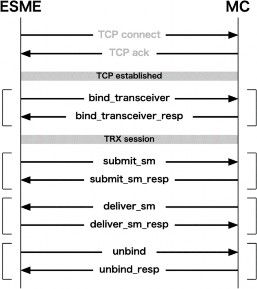
11.3 HTTP Implementation Overview
Swipe sideways to see the whole table →
Protocols | REST or HTTP/HTTPs, SOAP |
Payload Type | JSON, XML |
Security | SSL certificates for transport layer security, or VPN (any), JWT for client authentication and authorization |
11.4 SS7/SIGTRAN IMPLEMENTATION OVERVIEW
- https://www.eiconworks.com/DSI-SS7-Stack.asp
- https://www.enghousenetworks.com/portfolio/network-infrastructure/stp-signaling/
- https://www.gsma.com/membership/resources/coure-software-systems-inc-selects-dialogic-signaling- solution-offer-pan-african-number-management-security-services/
- https://comptek.ru/catalog/dialogic/
Swipe sideways to see the whole table →
Dialogic® DSI Signaling Transfer Point (DSI STP) based on the Dialogic DSI G5V Signaling Controller is a compact, cost-effective software only telecommunications signaling platform, providing core network connectivity for use in all-IP signaling environments. The DSI STP supports comprehensive Screening capabilities in addition to routing at the MTP and SCCP levels and Global Title Translation. The DSI STP features a browser-based graphical user interface (GUI) for all operations, administration, maintenance and provisioning functions. The GUI supports dynamic con?guration, status and alarm monitoring, interactive control and a wide range of diagnostic capabilities. A multi-user environment- complete with password security, con?gurable user privileges and full audit trail – adheres to chosen security policy. The DSI STP supports multiple protocol variants allowing worldwide deployment in both fixed and mobile networks. | Figure unavailable — Image_024.jpg |
Features | Benefits |
Software-only appliance for deployment under VMware or KVM using a single OVF distribution. | Allows the user to provision the optimal amount of resource and to select hardware platform of choice |
Worldwide protocol support (including ITU-T, ANSI, China, Japan) for both telephony and transaction- based operation with SCCP Global Title Translation | Facilitates global deployments and the ability to configure protocol variants at runtime |
Screening and routing based on OPC, DPC, SCCP Called & Calling Address, SSN, MAP Operation Code and others | Puts the operator in control of the way the network is used |
Supports built in browser and command line interface for OA&M in addition to SNMP | Facilitates comprehensive, user-friendly remote management using standard tools without the need for an expensive Element Manager |
Built-in periodic traffic measurements, event logging and protocol tracing (including PCAP format), backed by documented internal interfaces between protocol layers | Provides good visibility of utilization and traf?c levels; facilitates fast resolution of network protocol issues |
Ability to interwork between different network types including National/International, ETSI/ANSI and support for Alias Point Codes | Resolves basic interworking needs without requiring external protocol conversion |
11.5 Approach to the SS7 Based Solution
Openness
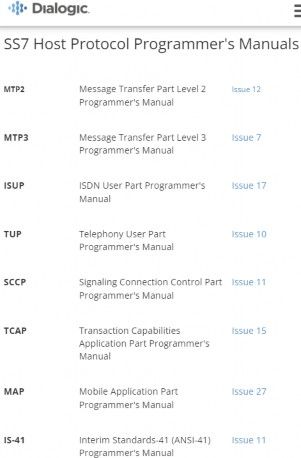
Microservices Architecture
Overview of the Modules and Sub-Modules
Swipe sideways to see the whole table →
Module | Purpose |
1. SS7 Core (Signaling System no 7) | Core signaling module for interconnection and SMS processing in the system. This is sourced from Dialogic through the DSI G5V programmable STP. |
2. Performance and Accounting | Listens for important signals (events) related to SMS traffic from the SS7 core, through microservices components and generates Accounting and Performance records. |
3. Management and Orchestration | This is the main microservices engine for synchronization and orchestration of all the services running in the platform. It also offers necessary features for operation and management of the system through graphical user interface (GUI), CLI, REST API and other tools. |
Swipe sideways to see the whole table →
Module | Sub-Module | Purpose |
1. SS7 Core | SIGTRAN Gateway (Signaling Gateway) | Allows SS7 applications to connect and communicate over IP Network. In our case, it allows the V-HUB to talk to the mobile network equipment e.g., SMSC, HLR and MSC that use protocols belonging the SS7 family. |
Load Balancer | Acts like an SBC in a voice network or a load balancer like NGINX for web applications. The load balancer extracts and distributes incoming SMS tasks or transactions among SMS gateway instances for further processing. This allows horizontal scalability and creates a highly scalable system. | |
SMS Gateway | This is responsible for the direct processing of SMS, for example forwarding by address manipulation or screening/blocking messages by filter parameters. It deals with the TCAP and MAP layer of the protocol stack, which This submodule or service can be deployed in multiple VMs for increased throughput or scalability; also fault tolerance. | |
2. Performance and Accounting | CDR Generator | Generates call records necessary for billing. The process listens for accounting event from the SS7 core and performs the tasks of starting and closing CDR records, also aggregating them in files or database for transferring to external billing systems. |
Overview of the Modules and Sub-Modules
- Flat and affordable Licensing
We take advantage of the bulk licensing capacity that Dialogic offers to us as an Original Equipment Manufacturer (OEM) which allows us to offer a cost-effective solution. We save our customers big on throughput licensing. Implementing powerful features like V-HLR and V-MSC easiliy
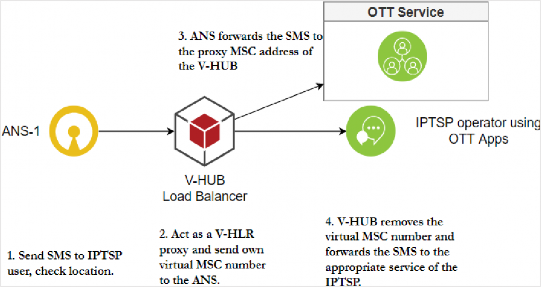
It may be required to implement advanced and customized features at any moment during the life time of the V-HUB project. For instance, the system may need to act as a V-HLR or V-MSC on behalf of an IPTSP/ PSTN operator so that the ANS can send SMS through the V-HUB to the PSTN subscribers using OTT Apps. Features like these can be easily implemented with the API offered by the Dialogic G5V programmable STP.
12. Protocol Signaling Requirements as per SMS Hubbing Standards
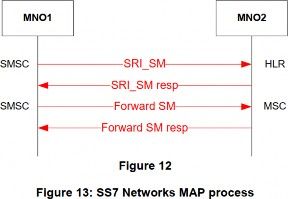
12.1.1. Signaling Requirements in Existing scenario (without OUR CUSTOMERS V-HUB in the path)
Swipe sideways to see the whole table →
| Description |
Subscriber generates SM. SMSC receives SM-MO and consults routing tables to define which HLR to request route from. | |
SMSC sends an SRI-SM to MNO2 HLR. | |
MNO2 HLR responds with MSC/VLR location of subscriber for delivery of SM-MT. | |
SMSC delivers SM-MT to subscriber via specified MSC/VLR. |
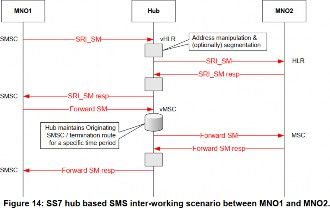
12.1.2. Signaling Requirements in proposed scenario (with OUR CUSTOMERS V-HUB in the path)
Swipe sideways to see the whole table →
| Stage | Description |
0 | Subscriber generates SM. SMSC receives SM-MO and consults routing tables to define which HLR to request route from. | |
1 | SMSC sends an SRI-SM to MNO2 HLR. | |
2 | MNO2 HLR responds with MSC/VLR location of subscriber for delivery of SM-MT. | |
3 | SMSC delivers SM-MT to subscriber via specified MSC/VLR. | |
4 | (optional) Delivery report generated. |
13. Working Mechanism of the V-HUB STP
Signal Transfer
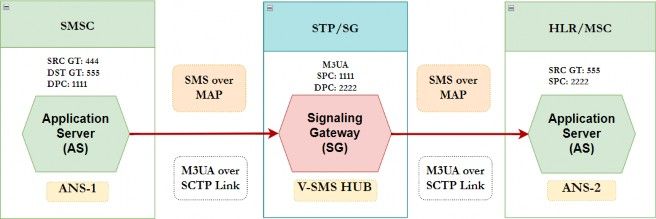
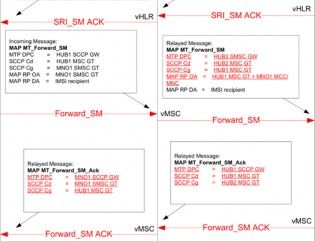
Address Manipulation by acting as VHLR, VMSC
SMS Screening
Transaction Handling
Accounting and Performance record (counters) generation
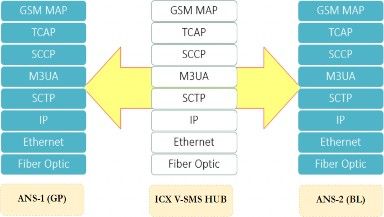
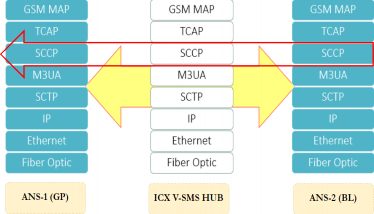
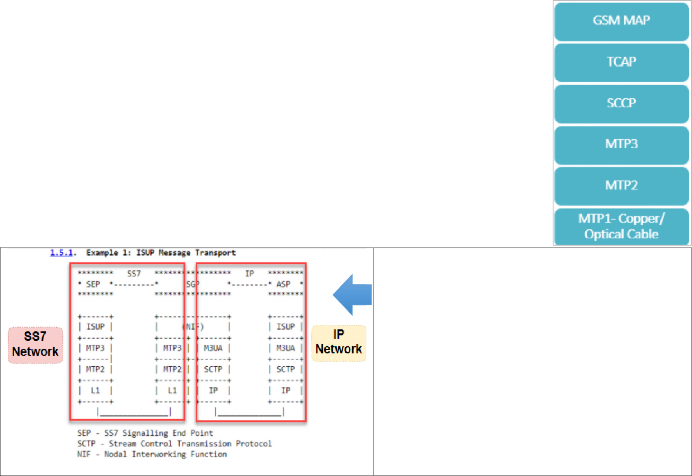
GSM MAP, along with TCAP protocols will be used at the V-HUB to connect with the ANS and exchange SMS traffic. These protocols run on top of other SS7 protocols which altogether makes the communication alive. SS7 was originally a protocol for the TDM network and the signaling traffic were used to carry through low speed signaling links. But as IP network evolved and became more popular, application-level protocols are now transported over high-speed IP networks. The RFP asks to implement SIGTRAN for transporting SMS traffic (MAP+TCAP) over IP network. The very high-level topology will look like this: